|

|
Processed through Paypal No account required. |








Buy our over-priced crap to help pay the bills.



|
|
Processed through Paypal No account required. |
| Files | ||||
| File Name | Rating | Downloads | ||
 |
EverythingToolbar v1.3.2 EverythingToolbar v1.3.2 Instant file search integration for the Windows taskbar powered by Everything. Features Light and Dark EverythingToolbar seemlessly blends into Windows 10 and 11 and adjusts according to your theme settings. Custom search filters EverythingToolbar reads custom filters previously defined in Everything. To enable this feature, check the Use Everything filters option in the EverythingToolbar settings. From now on, all filters will be available from the filter dropdown: Quick toggles for search options Quick access to search flags (match case, whole word, match path and reg-ex) allows you to find your files precisely. RegEx-powered file associations Create custom Open with commands by selecting Rules... in the preferences. By checking the Automatically apply rules based on condition checkbox, matching files/folders will execute the appropriate command based on the type and regular expression field. Leaving the regular expression field empty will never match, but the entry will only be displayed in the Open with context menu of the search results. Compatibility EverythingToolbar is compatible with both Windows 10 and Windows 11 and works well with tools like ExplorerPatcher and StartAllBack to give you the full deskband integration even on Windows 11. Other features: • Open EverythingToolbar at any time via a customizable shortcut • Redirect Start menu search to EverythingToolbar (experimental) • Drag and drop files to where you need them most • Quickly preview files thanks to QuickLook integration • Use custom Everything instance names Keyboard shortcuts Changes v1.3.2 Added preview support for Seer Fixed a bug related to number input (#455) Click here to visit the author's website. |
 |
3,623 | Nov 08, 2023 Stephan Rumswinkel 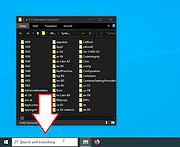 |
 |
SlunkCrypt v1.3.2 SlunkCrypt v1.3.2 An experimental cross-platform cryptography library. SlunkCrypt is an experimental cross-platform cryptography library and command-line tool. A fully-featured GUI is provided for the Windows platform. Encryption algorithm The SlunkCrypt algorithm is based on core concepts of the well-known Enigma machine but with numerous improvements, largely inspired by R. Anderson’s “A Modern Rotor Machine”: The original Enigma machine had only three (or, in some models, four) rotors, plus a static “reflector” wheel. In SlunkCrypt, we uses 256 simulated rotors for an improved security. Furthermore, the original Enigma machine supported only 26 distinct symbols, i.e. the letters A to Z. In SlunkCrypt, we use 256 distinct symbols, i.e. the byte values 0x00 to 0xFF, which allows the encryption (and decryption) of arbitrary streams of bytes, rather than just plain text. Of course, SlunkCrypt can encrypt (and decrypt) text files as well. In the original Enigma machine, the signal passes through the rotors twice, once in forward direction and then again in backwards direction – thus the “reflector” wheel. This way, the Enigma’s encryption was made involutory, i.e. encryption and decryption were the same operation. While this was highly convenient, it also severely weakened the cryptographic strength of the Enigma machine, because the number of possible permutations was reduced drastically! This is one of the main reasons why the Enigma machine eventually was defeated. In SlunkCrypt, the signal passes through the simulated rotors just once, in order to maximize the number of possible permutations. This eliminates the most important known weakness of the Enigma machine. Obviously, in SlunkCrypt, separate “modes” for encryption and decryption need to be provided, since encryption and decryption no longer are the same operation. In the original Enigma machine, the rightmost rotor was moved, by one step, after every symbol. Meanwhile, all ... |
|
2,608 | Nov 18, 2024 LoRd MuldeR 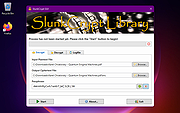 |
|
UltraVNC v1.3.2 UltraVNC v1.3.2 Ultra VNC is a powerful, easy to use and free - remote pc access softwares - that can display the screen of another computer (via internet or network) on your own screen. The program allows you to use your mouse and keyboard to control the other PC remotely. It means that you can work on a remote computer, as if you were sitting in front of it, right from your current location. VNC, the Remote Frame Buffer protocol (RFB) allows a desktop to be viewed and controlled remotely over the Internet. A VNC server must be run on the computer sharing the desktop, a VNC client must be run on the computer that will access the shared desktop. Click here to visit the author's website. |
|
8,242 | Dec 07, 2020 UltraVNC Team 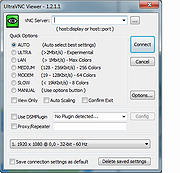 |
|
XL-Parser v1.3.2 XL-Parser v1.3.2 XL-Parser is a tool for data extraction and analysis. Input can be a directory, a file or multiple files, or the clipboard. File formats: XL-Parser supports many file formats like plain text, unicode, text inside binaries, doc and docx, xls and xlsx, evt and evtx, pdf, msg and text inside zip files. You can even extract a file using a different parser. For example, you can extract data from a docx file, but open it as a zip, so you will have access to xml file inside it. File filters: If the input is a directory, you can include the subfolder or not. You can also set a combinaison of filters: keyword or regex that match filename, size of the file, last modified time or last accessed time. Your combinaison of filters can be save for a later use. Extraction: You can extract data using a combinaison of keyword or regex or use the special objects already set which are: IPv4, IPv6, URLs, Emails, Hostnames, Domain names, MAC addresses or credit card numbers. XL-Parser provides a lot of options for extraction and for report. Web log analysis: One specialty of XL-Parser is web log analysis. When you analyse web logs, you can extract data using anything that is in the logs. For example, you can extract all requests related to a particular IP address, but you cannot search for requests related to an ISP, because this information is not in the log. XL-Parser provides you the way to do this and much more. First, XL-Parser will help you parse the log and build a SQlite database from it. When it's done, XL-Parser provides a bunch of functions to query the database and find suspicious activities. Cool! ... |
|
6,165 | Feb 27, 2019 Alain Rioux 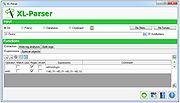 |
| Showing rows 1 to 4 of 4 | Showing Page 1 of 1 | 1 |
OlderGeeks.com Copyright (c) 2026
